




How Tourism Growth Affects Puerto Escondido Property Values
There is a version of Puerto Escondido that most of the world only recently discovered — a Pacific coast town where world-class surf, colonial fishing culture, and a growing international community all occupy the same few kilometers of Oaxacan coastline. But those of us who have watched this market closely over the past several years have witnessed something more than a tourism story. We have watched a direct, measurable relationship unfold between visitor growth and property values — one that is reshaping every neighborhood from Zicatela to Barra de Colotepec, and creating some of the most compelling real estate dynamics on Mexico’s southern Pacific coast.
The Numbers Behind Puerto Escondido’s Tourism Transformation
Understanding how tourism drives real estate requires looking honestly at the scale of what has happened here. Tourism arrivals in Puerto Escondido increased by 35% in 2024 compared to the prior year — a figure that stands well above the national average. According to data from INEGI (Instituto Nacional de Estadística y Geografía), Mexico received 47.8 million international tourists in 2025, a 6.1% increase over 2024. Puerto Escondido’s own growth has consistently outpaced that national benchmark, powered by a convergence of factors that are structural rather than cyclical.
The Barranca Larga–Ventanilla superhighway, completed in early 2024, cut travel time from Oaxaca City to roughly 2.5 hours — effectively erasing one of the destination’s last major friction points for domestic visitors. The result was immediate: Mexican families and urban weekenders who previously could not justify the trip began arriving in significant numbers, filling rental calendars during national holiday windows that had historically been dead periods for operators.
Then came the airport. Puerto Escondido International Airport (PXM) handled approximately 948,590 passengers in 2025 — up from barely 300,000 in 2018. The ongoing expansion, designed by architect Alberto Kalach and now managed by private operator Aeropuertos Mexicanos, targets 1.3 million annual passengers by 2027 and 1.8 million by 2032. In April 2025, United Airlines launched a direct weekly service from Houston, marking the destination’s first regular international connection to a major U.S. hub. Additional routes from Canadian cities and further U.S. gateways are in planning for 2026. That connectivity shift — moving Puerto Escondido from a destination that required a Mexico City connection to one with direct North American access — fundamentally changed the buyer pool for residential and investment properties here.
The population figures tell the same story from a different angle. Puerto Escondido’s population jumped from less than 30,000 in 2020 to nearly 47,000 in 2025, driven by a combination of tourism-sector employment, digital nomad migration, and international residents drawn by improved access. More people living and visiting translates directly into more demand for housing, accommodation, and commercial real estate — which is the foundational mechanism through which tourism converts into property value gains.
How Tourism Demand Translates Into Property Value Appreciation
The relationship between tourism growth and real estate appreciation is not automatic — it operates through several distinct channels, each of which plays out differently depending on the neighborhood and property type.
Vacation Rental Income and Investment Demand
The most direct channel is vacation rental income. When a destination attracts more visitors, nightly rates rise and occupancy strengthens. In Puerto Escondido’s core neighborhoods, beachfront and near-beachfront vacation rental properties in Zicatela now achieve 85–95% occupancy during the December–March peak, and the destination’s expanding tourism base has effectively compressed the traditional low season. Year-round demand — from surf travelers in the November–February competition window, digital nomads in La Punta who stay for weeks or months at a time, and domestic weekend visitors throughout the calendar — means that properties which once sat idle in May or June now generate meaningful revenue.
That income potential raises the investment case for residential property. A buyer who can project 8–12% gross rental yield from a well-positioned apartment or villa has a fundamentally different calculus than one who can only hope for seasonal income. According to AMPI (Asociación Mexicana de Profesionales Inmobiliarios), Mexican coastal markets with established vacation rental ecosystems consistently command a premium over comparable inland markets — and that premium widens as destinations gain international visibility. You can explore current apartments and condominiums available for this investment profile, as well as houses and villas suited to vacation rental strategies.
Scarcity and the Beachfront Land Constraint
Tourism growth does not just raise income — it also increases competition for a supply that cannot expand. The amount of beachfront and near-beachfront land in Puerto Escondido is finite. ZOFEMAT regulations govern the federal maritime zone along the coastline, limiting development immediately adjacent to the ocean. Municipal zoning within Santa María Colotepec and San Pedro Mixtepec imposes additional constraints on buildable land in coastal areas. As more buyers — both domestic and international — are drawn to Puerto Escondido by tourism growth, they compete for the same limited inventory. This supply constraint is structural, not temporary, and it underpins the appreciation trajectory even in scenarios where global tourism growth moderates.
Property values in central Zicatela appreciated approximately 18–22% in the 2024–2025 period. That figure reflects both the income-driven investment premium and the scarcity premium — two forces that reinforce each other when tourism growth is sustained. Explore the current land and lot listings in Puerto Escondido to understand where development opportunities still exist.
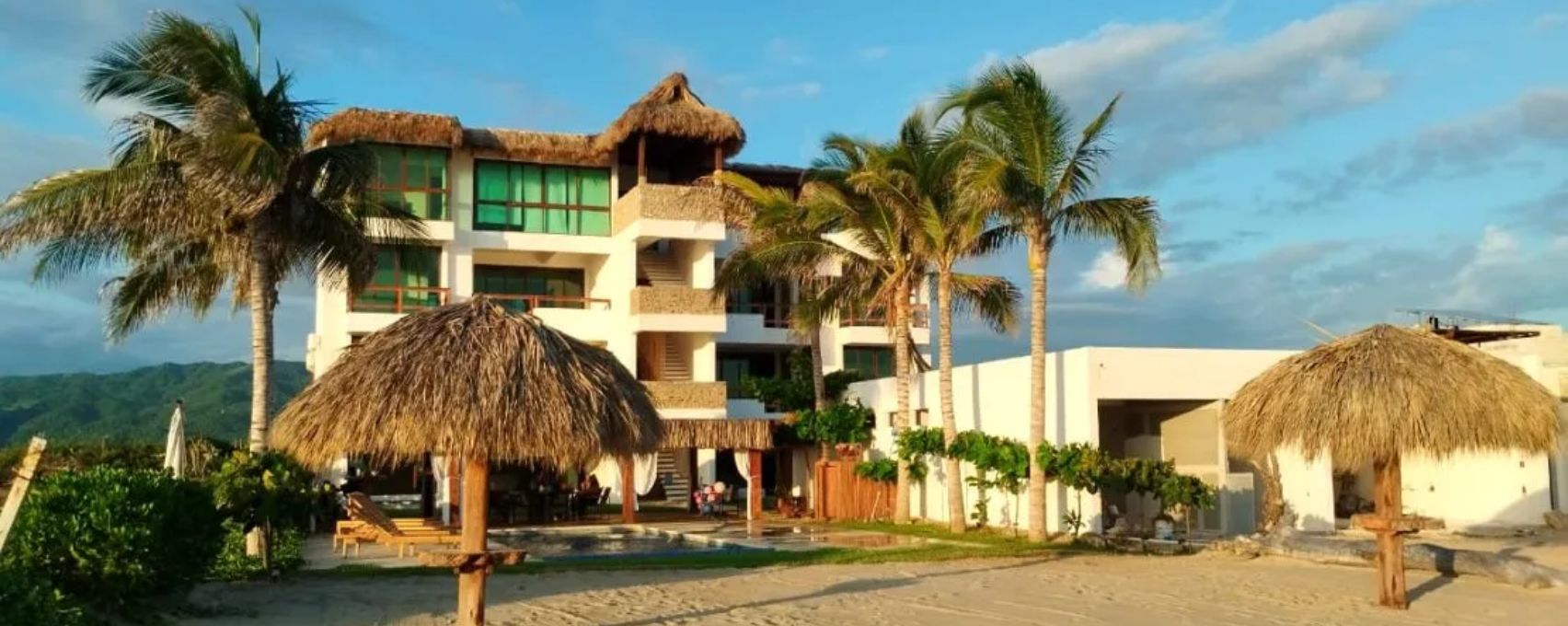
Neighborhood-by-Neighborhood: Where Tourism Impact Is Felt Most
The tourism-to-property-value relationship does not play out uniformly across Puerto Escondido. Each neighborhood has its own exposure to visitor demand, its own supply characteristics, and its own appreciation story.
Zicatela: The Core Market
Zicatela is where the tourism story began and where it remains most concentrated. The Mexican Pipeline — one of the world’s most photographed and feared surf breaks — built Puerto Escondido’s international reputation long before the superhighway or the airport expansion. That reputational anchor translates into a deep, diverse visitor base: competitive surfers chasing the November–February swell window, photographers and filmmakers documenting the wave, surf tourists who come to watch, and an increasingly mainstream international audience drawn by media coverage and social discovery.
For property owners, Zicatela’s visitor volume creates a vacation rental market that functions almost independently of seasons. Vacancy in a well-managed beachfront or near-beachfront property here is the exception rather than the rule across much of the calendar. That consistency, combined with the scarcity of remaining buildable lots close to the ocean, has driven the 18–22% appreciation figures recorded in 2024–2025. The neighborhood is transitioning from emerging to established — which means lower upside multiples but also significantly lower execution risk for investors.
La Punta: Tourism Meets the Digital Nomad Economy
La Punta occupies the southwestern tip of the Zicatela beach zone and has emerged as the destination’s most sophisticated address — a neighborhood where yoga studios, specialty coffee shops, and contemporary architecture coexist with surf culture. Its tourism appeal is distinct from Zicatela’s: La Punta attracts longer-stay visitors, particularly digital nomads and location-independent professionals who treat a two-week to two-month rental as their temporary home office.
That guest profile drives higher per-stay revenue for property owners and creates a demand for quality that keeps development standards elevated. Properties in La Punta that offer fast internet, thoughtful design, and amenity quality competitive with boutique hotels consistently outperform the neighborhood average on both occupancy and nightly rate. The tourism growth in this segment — wellness retreats, surf camps, remote-work retreats — adds a layer of demand that complements rather than duplicates the Zicatela model.
Carrizalillo and Bacocho: The Premium Beach Experience
Playa Carrizalillo — Puerto Escondido’s most protected cove, consistently recognized as one of Oaxaca’s most beautiful beaches — attracts a traveler profile that differs markedly from the surf crowd. Calmer waters, a sheltered crescent of sand, and the neighborhood’s relative tranquility appeal to families, couples, and higher-spending international visitors. That demographic shift in tourism translates directly into real estate: buyers and renters seeking Carrizalillo properties tend to have higher budgets and less sensitivity to market fluctuations.
Bacocho, adjacent to the Adoquín and Playa Principal, occupies the market position of Puerto Escondido’s quieter residential zone — popular with longer-term residents, established expats, and buyers prioritizing lifestyle over short-term rental yield. Tourism growth here is less volatile, more gradual, and tends to correlate with the destination’s overall reputation rather than with any single demand driver.
Emerging Zones: Punta Zicatela, Rinconada, and Barra de Colotepec
As tourism growth pushes demand beyond what established neighborhoods can absorb, adjacent areas come into focus. Punta Zicatela and the Rinconada corridor have benefited from overflow demand from central Zicatela. Buyers priced out of beachfront positions — or those seeking better value for their investment dollar — have found these areas compelling. Barra de Colotepec, further along the coastal corridor toward Santa María Colotepec municipality, remains one of the least-developed stretches of coastline accessible from Puerto Escondido, and early-stage investors are positioning there in anticipation of continued tourism-driven appreciation.
| Neighborhood | Primary Tourism Driver | Approximate Appreciation 2024–2025 | Vacation Rental Profile |
|---|---|---|---|
| Zicatela (beachfront / near-beach) | Surf tourism, international recognition | 18–22% | High volume, year-round, 85–95% peak occupancy |
| La Punta | Digital nomads, wellness, boutique travel | 16–20% | Longer stays, premium nightly rates |
| Carrizalillo | Family beach tourism, international buyers | 14–18% | High season dominant, premium segment |
| Bacocho | Lifestyle residents, long-term expats | 10–14% | Mixed short and long-term rentals |
| Punta Zicatela / Rinconada | Overflow demand from Zicatela | 15–20% | Growing vacation rental uptake |
| Barra de Colotepec | Early-stage development, land speculation | Variable — early stage | Largely undeveloped, high upside potential |
Tourism Growth and the Hospitality Real Estate Opportunity
Tourism growth does not benefit only residential property. It creates a parallel opportunity in hospitality and commercial real estate — hotels, guesthouses, boutique lodging — that is often overlooked by buyers focused exclusively on condominiums and villas.
According to Inmobiliare, one of Mexico’s leading real estate industry publications, coastal hospitality assets in markets that have recently gained international air access consistently rank among the country’s strongest performers in the years immediately following connectivity upgrades. Puerto Escondido’s April 2025 United Airlines Houston route fits that profile precisely. Boutique hotel and guesthouse projects in Zicatela, La Punta, and Carrizalillo are benefiting from rising nightly rates and occupancy figures that now run year-round rather than seasonally. The arrival of more international visitors through PXM expansion only deepens that demand as the destination’s tourist mix shifts toward higher-spending international travelers.
For investors with a hospitality orientation, the current window — before additional international routes are established and before the new terminal reaches capacity — represents the clearest entry point. You can view current hotel and business properties available in Puerto Escondido for opportunities across the spectrum from boutique guesthouses to development-stage parcels in strategic locations.
Sustainability, Community, and Long-Term Value Preservation
No serious analysis of tourism and real estate in Puerto Escondido can ignore the sustainability dimension. The community here has been remarkably active — and remarkably effective — in pushing back against development that threatens the natural assets underpinning the destination’s appeal. The 2025 World Surfing Reserve designation, championed by the local Salvemos Puerto Escondido coalition, formally recognized eight waves and 6.2 miles of coastline containing critical biodiversity. That designation matters for real estate investors because it signals that regulatory and community frameworks exist to protect the very features — waves, beaches, natural coastline — that generate tourism demand in the first place.
Properties and developments that align with this sustainability orientation — thoughtful architecture, coastal setbacks, respect for ZOFEMAT boundaries, environmental sensitivity — tend to command premiums in this market and face fewer regulatory complications than those that do not. The long-term value case for Puerto Escondido real estate is inseparable from the long-term preservation of the destination’s natural character. That is something to weigh carefully when evaluating any specific property or development project.
Investors should also remain aware that zoning rules within Santa María Colotepec and San Pedro Mixtepec municipalities continue to evolve as growth accelerates. Working with a qualified local notario público and, where applicable, an abogado familiar with Oaxacan coastal regulations is essential before any purchase. Foreign buyers purchasing within the restricted zone will require a fideicomiso (bank trust) to hold title — a well-established legal instrument that grants full rights of use and sale, but one that must be structured correctly from the outset. Browse all available properties in Puerto Escondido to begin understanding the market landscape, and check current hot sale listings for time-sensitive opportunities.
Frequently Asked Questions
How has tourism growth affected property values in Puerto Escondido?
Tourism growth has been a primary driver of real estate appreciation here. Tourism arrivals grew 35% in 2024, and core neighborhoods like Zicatela and La Punta recorded property value appreciation of 18–22% in the 2024–2025 period. Stronger visitor demand creates rental income potential, which raises the investment value of residential and commercial properties across the market.
Which Puerto Escondido neighborhoods benefit most from tourism-driven appreciation?
Zicatela and La Punta have seen the strongest direct impact, given their beach proximity and high vacation rental occupancy. Carrizalillo and Bacocho attract premium buyers seeking calmer beach access. Emerging areas like Punta Zicatela, Los Tamarindos, and Barra de Colotepec are benefiting as overflow demand pushes buyers beyond the established core.
Can foreigners buy property in Puerto Escondido?
Yes. Foreign nationals can purchase property in Puerto Escondido through a fideicomiso — a bank trust — when the property falls within Mexico’s restricted zone (within 50 km of the coastline). The fideicomiso grants the buyer full rights of use, enjoyment, and sale. A notario público oversees the transaction and formalizes the escritura (title deed).
How does the Puerto Escondido airport expansion impact real estate investment?
PXM handled nearly 950,000 passengers in 2025, up from roughly 300,000 in 2018. The new terminal targets 1.3 million annual passengers by 2027. The April 2025 direct United Airlines route from Houston significantly expanded the pool of potential buyers and renters, directly increasing demand for residential and hospitality properties across the destination.
Is Puerto Escondido real estate a good investment in 2026?
Market fundamentals remain strong. Infrastructure improvements, growing international connectivity, the World Surfing Reserve designation, and a structurally constrained land supply all support continued appreciation. Vacation rental yields in core neighborhoods are estimated at 8–12% gross for well-managed properties, with additional upside from capital gains. As with any investment, professional advice from a local notario, abogado, and contador is strongly recommended before purchasing.
Conclusion
Puerto Escondido’s tourism transformation — measured in passenger numbers, visitor arrivals, population growth, and global media attention — is not a background trend for real estate. It is the central engine of value creation in this market. The superhighway, the airport expansion, the United Airlines route, the World Surfing Reserve designation, and the deepening digital nomad economy are not isolated events; they are reinforcing chapters of the same story. For buyers and investors who understand how these forces connect to property values at the neighborhood level, this remains one of the most compelling coastal real estate opportunities on the Mexican Pacific. If you are ready to explore what is currently available, our team is here to help — browse our full property listings or reach out directly for a personalized consultation on the Puerto Escondido market.
Disclaimer: The information contained in this article is provided for general informational purposes only and does not constitute legal, financial, or investment advice. Real estate markets are subject to change. Readers are strongly encouraged to consult with a qualified notario público, abogado, and contador before making any property purchase in Mexico. Pierre Nicolas Lussault and Real Estate Puerto Escondido make no representations as to the accuracy or completeness of any information on this site or found by following any link on this site.