

Puerto Escondido Rental Market Analysis 2026: Occupancy, Trends & Investment Outlook
Puerto Escondido has crossed a threshold. What was once a niche surf destination known to a small international community has become one of Mexico’s most closely watched rental markets, drawing investors from North America, Europe, and beyond. With properties across Zicatela, La Punta, Carrizalillo, and Bacocho generating measurable returns year-round, understanding the dynamics behind that performance is essential for anyone considering a purchase or looking to optimize an existing rental portfolio in 2026.
This analysis draws on current occupancy data, seasonal patterns, neighborhood comparisons, and the structural forces — infrastructure, tourism growth, and changing guest profiles — that are shaping the market right now. Whether you are evaluating your first investment or refining a strategy for a property you already own, the numbers and trends covered here offer a grounded, practical picture of where the Puerto Escondido rental market stands heading deeper into 2026.
The Macro Context: Why Puerto Escondido’s Rental Market Is Outperforming
Rental market performance does not exist in isolation. Understanding why Puerto Escondido is generating strong occupancy numbers in 2026 requires a look at the broader forces driving demand, both nationally and locally.
At the national level, Mexico’s tourism sector closed 2025 with record results. According to data from INEGI (Instituto Nacional de Estadística y Geografía), Mexico received 47.8 million international tourists in 2025, a 6.1% increase over 2024. Domestic tourism also expanded, with domestic travelers accounting for more than 55% of hotel check-ins across the country last year — a resilience indicator that matters for a destination like Puerto Escondido, which captures meaningful flows of Mexican domestic visitors during Semana Santa, summer school holidays, and long weekends throughout the year.
Locally, Puerto Escondido’s own demand drivers have matured considerably. Tourism arrivals in Puerto Escondido increased by 35% in 2024 compared to the prior year, and preliminary indicators for 2025 point to continued growth. Three structural catalysts underpin this trajectory:
- Direct international air access: United Airlines launched a direct Houston–Puerto Escondido route in April 2025, the first international connection of its kind, reducing friction for North American visitors significantly.
- The Barranca Larga–Ventanilla superhighway: Completed in 2023, this road cut the Oaxaca City–Puerto Escondido journey from roughly six hours to approximately 2.5 hours, creating a viable weekend-trip market from the state capital and interior Mexico.
- World Surfing Reserve designation: Puerto Escondido received this designation in 2025, cementing its global surf tourism profile and driving media coverage that reaches a highly motivated, travel-ready audience.
The result is a destination that now draws surfers, digital nomads, wellness travelers, retirees, families, and luxury tourists simultaneously — a diversity of guest profiles that translates directly into rental market resilience across the full calendar year.
Seasonal Occupancy Patterns: A Full-Year Picture
One of the most important lessons for rental investors in Puerto Escondido is the difference between peak-season performance and annual performance. Properties that shine in December and January can tell a misleading story if low-season realities are not factored in carefully.
Peak Season: December Through March
The primary high season runs from December through March, driven by North American winter travel, European escapes, and the surf season at Zicatela. During this four-month window, well-positioned listings in areas like Zicatela beachfront, La Punta, and Carrizalillo achieve occupancy rates of 85–95%, with December and January representing the absolute peak. Minimum stay requirements typically extend to five to seven nights during this period, and properties in prime locations book out months in advance.
The international surf competition circuit at Zicatela, which typically runs events between November and February, adds a concentrated demand spike for properties near the Mexican Pipeline — Zicatela’s legendary beach break. During competition weeks, adjacent neighborhoods see occupancy push toward capacity even when they would otherwise be tracking slightly below peak levels.
Secondary Peaks: Semana Santa and Summer
Semana Santa — Holy Week, falling in late March or April — functions as a second peak season that rivals December and January in intensity. Mexican domestic travel surges during this window, filling properties across all neighborhoods rapidly. Investors who underweight Semana Santa in their revenue projections consistently underestimate annual income potential.
July and August deliver a third demand period, coinciding with European and North American summer school holidays. Occupancy during these months typically runs between 70–85% for well-managed listings, with family-oriented properties in Carrizalillo and Bacocho performing particularly well as parents seek calm, swimmable water for children.
Low Season: May, June, September, October
The low season corresponds to the rainy season and, at its extreme end, hurricane season along the Oaxacan coast. Occupancy softens but does not collapse for properties with established reputations and multi-platform visibility. Properties actively targeting digital nomads and long-stay guests — marketing monthly rates, emphasizing reliable high-speed internet, and positioning near La Punta’s coworking-friendly café culture — can sustain 50–65% effective occupancy during these months, even accounting for extended stay discounts. Properties that rely solely on traditional leisure tourist bookings, without adapting their offer or pricing strategy, are more likely to see occupancy drop into the 30–45% range during the quietest weeks.
| Period | Months | Demand Driver | Estimated Occupancy Range |
|---|---|---|---|
| Peak Season | December – March | Surf season, North American winter, international tourism | 85–95% |
| Semana Santa | Late March – April | Mexican domestic travel peak | 85–95% |
| Summer | July – August | European & North American school holidays, family travel | 70–85% |
| Shoulder Season | November, early December | Pre-peak surf demand, early arrivals | 60–75% |
| Low Season | May, June, September, October | Digital nomads, long-stay guests, reduced leisure travel | 45–65% |
Note: Ranges reflect market observations for well-managed properties with active multi-platform marketing. Individual results vary based on property condition, location within neighborhood, amenity quality, and management approach.
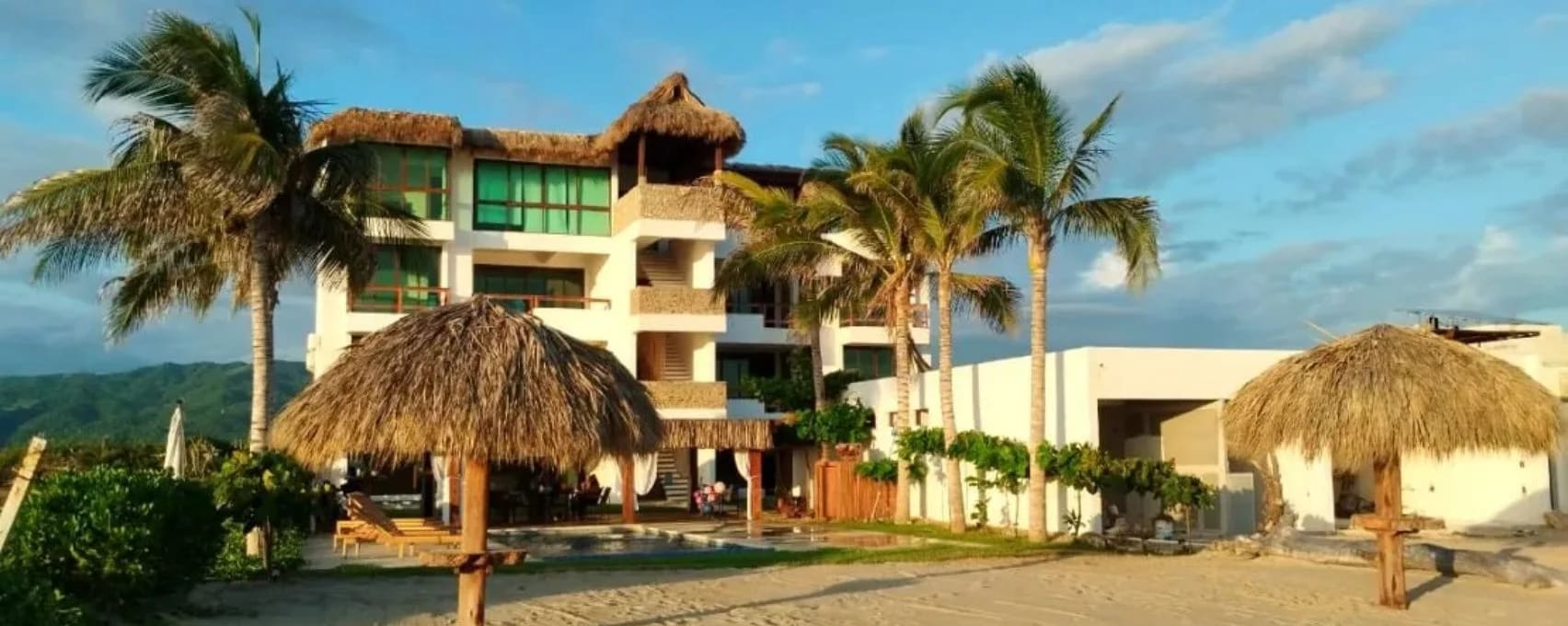
Neighborhood Performance: Where Each Zone Stands in 2026
Puerto Escondido is not a single rental market — it is a collection of distinct micro-markets, each with its own guest profile, seasonal curve, and performance ceiling. A clear-eyed neighborhood comparison is essential for matching an investment strategy to a specific location.
Zicatela: Volume, Surf Tourism, and Year-Round Demand
Zicatela remains Puerto Escondido’s most internationally visible neighborhood, anchored by the Mexican Pipeline — one of the most powerful beach breaks in the world. Its appeal stretches well beyond surfers: the 3.5-kilometer beachfront strip supports a dense ecosystem of restaurants, bars, surf schools, yoga studios, and boutique guesthouses that attract a culturally curious international crowd year-round.
For rental investors, Zicatela delivers the strongest combination of occupancy volume and year-round demand consistency. Beachfront and near-beachfront properties achieve 85–95% occupancy during the December–March peak. Even properties two to three blocks inland maintain competitive rates during high season. The surf competition circuit keeps a base layer of demand running through the November–February window, while the neighborhood’s longstanding reputation on international booking platforms drives organic discovery year-round. Property values in central Zicatela appreciated approximately 18–22% in 2024–2025, and that trajectory is expected to continue as international access improves.
La Punta: Digital Nomads, Long Stays, and Social Energy
La Punta has emerged as Puerto Escondido’s most dynamic neighborhood for a specific and highly valuable guest segment: digital nomads and location-independent professionals seeking stays of two weeks to two months. The neighborhood’s combination of reliable internet infrastructure (many properties have Starlink access), walkable access to cafés and coworking spots, and a social scene anchored by the famous sunset viewpoint creates a self-reinforcing demand loop that sustains occupancy during months when leisure-only destinations quiet down significantly.
La Punta landlords benefit from a base layer of longer-stay bookings that smooth out the annual revenue curve. While peak-season nightly rates in La Punta trail Zicatela beachfront slightly, the consistency of monthly rental demand during shoulder and low seasons partially offsets this gap. For investors seeking stable cash flow with lower management friction — fewer turnovers, longer average stays — La Punta represents one of the most compelling options in the current market. Apartments and condominiums in La Punta are particularly well-suited to this long-stay profile.
Carrizalillo: Scarcity, Premium Rates, and Family Appeal
Carrizalillo sits above one of Puerto Escondido’s most protected and visually striking coves — a calm, sheltered bay that offers swimmable water, snorkeling, and a dramatically different atmosphere from the open Pacific at Zicatela. The geography that makes Carrizalillo so appealing also constrains its supply: the hillside topography limits the number of buildable lots, which supports both property values and rental pricing power.
Properties with direct views over the cove consistently outperform the neighborhood average. The guest profile here skews toward families, couples celebrating special occasions, and retreat organizers seeking exclusive, photogenic accommodations. High-season occupancy at well-positioned Carrizalillo properties is exceptional. The trade-off is that low-season occupancy gaps are more pronounced than in Zicatela or La Punta — the family audience that drives Carrizalillo’s peak is concentrated in specific holiday windows rather than distributed across the year.
Bacocho: Luxury, Privacy, and Group Stays
Bacocho is Puerto Escondido’s upmarket residential zone, positioned on the western side of the bay. Properties here tend to be larger — standalone villas and houses set in landscaped grounds — and the guest profile skews toward affluent families, honeymoon couples, and retreat or corporate group bookings. Nightly rates in Bacocho can be the highest in the market for the right property, reflecting the privacy, space, and amenity quality that this audience demands.
The management challenge in Bacocho is low-season occupancy. Luxury travelers concentrate in peak periods, and the off-season gap in Bacocho is more pronounced than in any other major neighborhood. Successful operators in this zone typically implement aggressive low-season pricing strategies — discounts of 40–50% below peak rates — and actively market to special occasion and group travel segments (destination weddings, family reunions, corporate retreats) to bridge the annual revenue curve.
Rinconada / Rinconcito and Sector Reforma: Emerging Value Plays
These adjacent zones, positioned between Carrizalillo’s elevated geography and the broader Zicatela corridor, are increasingly on investors’ radar as beachfront prices in Zicatela and La Punta have climbed. The boutique, quieter character of Rinconada appeals to a discerning traveler segment that values authenticity and proximity to both calm water and surf culture without the density of central Zicatela. For investors seeking entry points at more accessible valuations while still capturing the Puerto Escondido tourism wave, this zone deserves careful consideration.
| Neighborhood | Primary Guest Profile | Peak Occupancy | Low-Season Occupancy | Year-Round Consistency | Best Property Type |
|---|---|---|---|---|---|
| Zicatela | Surfers, international tourists, digital nomads | 85–95% | 50–65% | High | Studios, 1–2BR condos |
| La Punta | Digital nomads, long-stay guests, couples | 80–90% | 55–70% | Very High | Apartments, small villas |
| Carrizalillo | Families, couples, boutique travelers | 85–95% | 35–55% | Moderate | Villas, houses with views |
| Bacocho | Luxury families, groups, special occasions | 80–90% | 25–40% | Lower (luxury concentration) | Large villas, private estates |
| Rinconada / Rinconcito | Boutique travelers, families, wellness retreats | 75–85% | 40–55% | Moderate | Houses, boutique properties |
What Is Driving Demand in 2026: Structural Trends Investors Should Understand
Beyond seasonal patterns, several structural trends are reshaping demand in ways that will influence the rental market over the medium term. Investors who understand these forces will be better positioned to select properties and design rental strategies that outperform the market average.
The Digital Nomad Layer
The remote work shift that accelerated during the pandemic years has matured into a stable demand segment for Puerto Escondido. Location-independent professionals — from software developers and designers to consultants and content creators — are choosing Puerto Escondido for its combination of reliable connectivity, outdoor lifestyle, and relatively affordable cost of living compared to other international digital nomad hubs. La Punta and Zicatela are the primary beneficiaries of this trend. Properties with verified high-speed internet (particularly Starlink-equipped listings), dedicated workspace, and comfortable air conditioning consistently outperform comparable properties lacking these features, and they tend to attract longer stays — two to four weeks or even monthly bookings — which reduces management overhead considerably.
Mexican Domestic Tourism
The reduction in Oaxaca City–Puerto Escondido travel time to approximately 2.5 hours has effectively created a new domestic weekend-break market. Mexican families, couples, and groups who previously found the journey prohibitive now make the trip for long weekends, national holidays, and impromptu getaways. According to INEGI, domestic tourism in Mexico grew by approximately 13.7% in 2025, with coastal destinations benefiting disproportionately from this trend. For rental investors in Puerto Escondido, this creates meaningful occupancy during Mexican national holiday windows — such as Día de Muertos in early November, the December bridge holidays, and various civic observances — that previously fell in the low-season gap.
Retreat and Wellness Travel
Puerto Escondido’s combination of natural setting, surf culture, and relative accessibility from major cities in North America and Europe has attracted a growing ecosystem of yoga retreats, surf camps, wellness workshops, and spiritual travel experiences. These retreat organizers are a distinct and valuable rental segment: they book in advance, they take entire properties for multiple days or weeks, and they introduce the destination to their participants — many of whom return as individual guests. Properties in Bacocho, Carrizalillo, and upper Zicatela are well suited to this segment, particularly those with private pools, multiple bedrooms, and outdoor living areas.
International Air Access and Booking Windows
The arrival of United’s Houston route in April 2025 has not just brought more visitors — it has extended booking windows. Guests arriving from the United States directly are more likely to plan their trip two to four months in advance, which improves cash flow predictability for property owners. According to AMPI (Asociación Mexicana de Profesionales Inmobiliarios), improved air connectivity historically correlates with higher average nightly rates and longer average stays in emerging coastal destinations, both of which are trends already visible in Puerto Escondido’s current booking data.
Legal and Tax Considerations for Rental Property Owners
Operating a vacation rental in Puerto Escondido as a foreign owner involves a straightforward but non-negotiable legal and fiscal framework. Getting these elements right from the start protects your investment and ensures you can operate without interruption.
Property Ownership Structure: The Fideicomiso
Puerto Escondido’s coastal properties fall within Mexico’s Zona Restringida — the zone extending 50 kilometers inland from the coast where foreign nationals cannot hold direct title to real estate. The standard mechanism for foreign ownership is the fideicomiso, a bank trust administered by a Mexican banking institution in which the foreign buyer is the beneficiary. The fideicomiso grants full rights to use, rent, modify, and sell the property, while the bank holds nominal legal title. This structure is fully legally recognized, widely used, and does not materially restrict rental activity. Your notario público manages the trust establishment as part of the closing process.
Rental Income Taxation
Rental income generated in Mexico is subject to Mexican income tax (ISR — Impuesto Sobre la Renta). Foreign owners renting Mexican properties must register with the SAT (Servicio de Administración Tributaria) and issue digital invoices (CFDIs) for rental income. Mexico permits deductions for qualifying operating expenses, including property management fees, maintenance, utilities, insurance, and depreciation — which can meaningfully reduce the effective tax rate on net income. Working with a qualified Mexican contador (accountant) who is familiar with vacation rental taxation is strongly recommended, both to ensure compliance and to optimize your deductions. Tax obligations in your country of residence may also apply, depending on your nationality and residency status.
Municipal Licensing and Short-Term Rental Registration
Properties within the municipality of Santa María Colotepec — which encompasses Zicatela and surrounding areas — and San Pedro Mixtepec, which covers parts of the Centro and Bacocho zones, may be subject to municipal licensing requirements for commercial rental activity. Requirements and enforcement vary, and it is advisable to confirm the current regulatory environment with a local legal advisor or directly with the relevant municipal authority before launching a rental operation.
Platform and Withholding Obligations
Major short-term rental platforms operating in Mexico, including Airbnb and VRBO, are required under current Mexican fiscal regulations to report host income to the SAT and withhold a percentage of earnings on behalf of registered hosts. This mechanism has simplified tax compliance for many casual rental operators, but professional investors typically benefit from a more comprehensive approach — one that properly accounts for all deductible expenses and structures income efficiently through professional tax guidance.
Investment Strategy Implications: Matching Property to Approach
The rental market data points above translate into distinct strategic choices depending on what an investor is optimizing for. There is no single “best” property in Puerto Escondido — there is a best property for each specific strategy.
Maximizing Annual Gross Revenue
For investors prioritizing total rental income, Zicatela beachfront and near-beachfront properties offer the highest combination of peak-season rates and year-round demand consistency. A well-positioned studio or one-bedroom unit in Zicatela, professionally managed across multiple booking platforms, can achieve annual blended occupancy in the 65–75% range — translating into substantial gross rental income relative to acquisition cost.
Minimizing Management Complexity
Investors seeking income with lower operational overhead should consider La Punta apartments targeting the digital nomad and long-stay segment. Fewer turnovers, longer average stays, and a guest profile that is less demanding in terms of daily service reduce both management time and cost, while maintaining solid occupancy through the quieter months.
Premium Positioning and Capital Appreciation
Carrizalillo villas and Bacocho estates offer the highest nightly rates and strongest capital appreciation potential for investors willing to accept a more concentrated seasonal revenue curve. These properties also benefit from significant scarcity — there is simply limited land in Carrizalillo, and large, private Bacocho estates represent a finite inventory. Browse available hot sale properties to see what is currently available across these zones.
Emerging Neighborhoods for Value Entry
Investors seeking to enter the market at lower acquisition points while still capturing the broader tourism growth wave should look at Rinconada, Rinconcito, and the Santa María Colotepec coastal corridor toward Barra de Colotepec. These areas are on the trajectory that Zicatela and La Punta were on a decade ago — benefiting from improved infrastructure, increasing tourism visibility, and growing foreign buyer interest, while still offering more accessible entry valuations. Vacant land in these zones also presents development opportunities for investors with a longer time horizon.
2026 Outlook: Opportunities and Risks to Monitor
The Puerto Escondido rental market enters 2026 with strong fundamentals: growing international and domestic demand, improved infrastructure, and a diversifying guest base that supports year-round occupancy more robustly than at any prior point in the destination’s history. That said, a grounded investment analysis requires honest acknowledgment of both the opportunities and the risks on the horizon.
Opportunities
- Additional international air routes: Canadian and further U.S. connections planned for 2026 could add meaningful new visitor flows and extend the booking horizon for North American travelers.
- Growing retreat and wellness economy: As Puerto Escondido’s wellness travel reputation solidifies, well-designed properties with private pools and multi-bedroom layouts are positioned to capture high-value group bookings that command premium rates.
- Digital nomad infrastructure growth: Continued coworking space development, improved internet infrastructure, and community-building initiatives in La Punta and Zicatela will deepen the long-stay demand layer that has become one of the most valuable occupancy stabilizers in the market.
- Domestic tourism expansion: The superhighway connection to Oaxaca City will continue generating domestic weekend visitors — a market that remains underserved by professionally managed vacation rentals compared to the international segment.
Risks to Monitor
- Supply growth: Puerto Escondido’s rental market has attracted significant new inventory over the past three years. Continued supply growth — particularly in Zicatela and La Punta — could put modest pressure on occupancy rates and nightly rates in those neighborhoods, particularly during shoulder and low season.
- Regulatory evolution: Short-term rental regulation in Mexico is evolving at both federal and municipal levels. Investors should monitor developments in both Santa María Colotepec and San Pedro Mixtepec municipal frameworks, as well as potential changes to platform withholding regulations from the SAT.
- Infrastructure gaps: Water supply reliability and electricity stability remain real operational considerations in certain parts of the market, particularly during peak season when demand concentrates. Properties with backup water cisterns and power stabilizers are operationally more resilient.
- Global economic uncertainty: A significant slowdown in the U.S. or European economies could reduce international leisure travel to emerging destinations. Puerto Escondido’s growing domestic tourism base provides a partial hedge, but a sustained international demand contraction would affect the market.
Frequently Asked Questions: Puerto Escondido Rental Market 2026
What is the average occupancy rate for vacation rentals in Puerto Escondido in 2026?
Well-managed, well-located properties in Puerto Escondido are achieving 80–95% occupancy during the peak season (December through March), while annual blended occupancy for professionally managed listings typically falls between 65–75%, depending on neighborhood and property type. Properties optimized for digital nomads and long-stay guests in La Punta can sustain 50–65% effective occupancy during the low season, significantly outperforming properties relying solely on leisure bookings.
Which neighborhood in Puerto Escondido generates the best rental income?
Zicatela leads in volume and year-round demand consistency due to surf tourism and its dense tourism ecosystem. La Punta offers the most stable annual occupancy curve, driven by digital nomads and long-stay guests. Carrizalillo commands some of the highest nightly rates given its limited supply and premium cove setting. Bacocho targets luxury and group stays with the highest individual nightly rates but the most pronounced low-season gap. The “best” neighborhood depends on your investment strategy and risk tolerance.
When is the peak rental season in Puerto Escondido?
The primary peak runs from December through March, coinciding with North American winter and the Zicatela surf season. Secondary demand spikes occur during Semana Santa (March–April) and July–August with European and North American summer holidays. The international surf competition circuit adds concentrated demand to Zicatela between November and February.
Can foreigners legally rent out property in Puerto Escondido?
Yes. Foreign buyers typically hold coastal property through a fideicomiso (bank trust) and may legally rent it on a short- or long-term basis. Rental income must be declared to Mexico’s SAT, and invoicing through the CFDI system is required. A qualified Mexican contador familiar with vacation rental taxation is strongly recommended to ensure compliance and optimize deductions. Always consult a qualified notario público and legal advisor for guidance specific to your situation.
How has the new superhighway affected rental demand in Puerto Escondido?
The Barranca Larga–Ventanilla superhighway, completed in 2023, reduced travel time from Oaxaca City from roughly six hours to approximately 2.5 hours. This has opened the destination to a meaningful flow of domestic weekend visitors and national holiday travelers — a demand layer that supplements international tourism and helps smooth the annual occupancy curve for properties in all major neighborhoods.
Conclusion
Puerto Escondido’s rental market in 2026 is more sophisticated, more resilient, and more opportunity-rich than at any point in the destination’s recent history. The combination of improved infrastructure, a diversifying guest base, and sustained national and international tourism growth has created a market where well-chosen, professionally managed properties generate meaningful returns across a broad range of investment strategies. The window for entering at favorable valuations continues to narrow — particularly in established neighborhoods where supply constraints are already visible. If you are considering a rental investment in Puerto Escondido, the moment to act is now, before the next round of appreciation works against your entry point.
Our team at Real Estate Puerto Escondido works exclusively in this market and brings hands-on knowledge of neighborhood dynamics, rental performance benchmarks, and the legal framework for foreign buyers. Whether you are seeking your first investment property or expanding an existing portfolio, we are here to help you navigate the process with transparency and local expertise. Explore our blog for more in-depth market analysis, or reach out directly to schedule a consultation.
Follow us on Instagram, Facebook, and LinkedIn for regular updates on market trends and new listings.
Disclaimer: The occupancy ranges and market observations in this article are based on available market data and professional experience in the Puerto Escondido real estate market. They are provided for informational purposes only and do not constitute guaranteed returns or investment advice. All real estate investments carry risk. Consult a qualified real estate professional, notario público, and legal advisor before making any investment decision.
Browse Available Properties
Find Your Place in Puerto Escondido
Beachfront lots, ocean-view condos, and income-generating vacation rentals — updated daily.
View All Properties