



Traditional Mexican Homes in Puerto Escondido: Architecture, Culture & Real Estate Value
Walk through any colonia in Puerto Escondido — from the surf-worn streets of Zicatela to the quieter lanes above Carrizalillo — and you will notice that the most captivating homes share something in common: they look like they belong exactly where they are. Palm roofs that breathe with the ocean wind, thick walls that hold the cool through the afternoon heat, open living spaces where inside and outside feel like the same room. These are not design trends imported from somewhere else. They are the expression of centuries of Mexican building knowledge, adapted over generations to this specific stretch of the Oaxaca coast. For buyers and investors today, understanding traditional Mexican home styles is not just a matter of aesthetics. It is a practical guide to what makes a property in Puerto Escondido genuinely valuable, liveable, and lasting.
The Roots of Traditional Mexican Coastal Architecture
Mexico’s vernacular architecture has never been uniform. As documented by INEGI, Mexico’s regional diversity — in climate, materials, and indigenous heritage — has always shaped how people build. On the Pacific coast of Oaxaca, three broad forces have defined the traditional home: the climate, the materials available, and the cultural traditions of the Zapotec and later mestizo communities who settled the coast.
The coastal climate of Puerto Escondido is hot and humid for much of the year, with a marked rainy season running from June through October. The architectural response to these conditions — developed long before air conditioning existed — relied on shade, airflow, and thermal mass. Thick walls absorb heat during the day and release it slowly at night. Overhanging roofs keep walls and interiors shaded. Open-plan spaces allow cross-breezes to move freely through the home. These principles, embedded in traditional buildings, remain the most effective passive cooling strategies available on this coast today.
The availability of local materials further defined the regional style. Palm thatch, hardwoods such as parota and macuil, volcanic stone, and hand-formed adobe bricks were the building blocks of coastal Oaxacan homes for generations. Each material carried its own thermal logic, its own relationship to rain and sun, and its own aesthetic character — warm, textured, and unmistakably rooted in place.
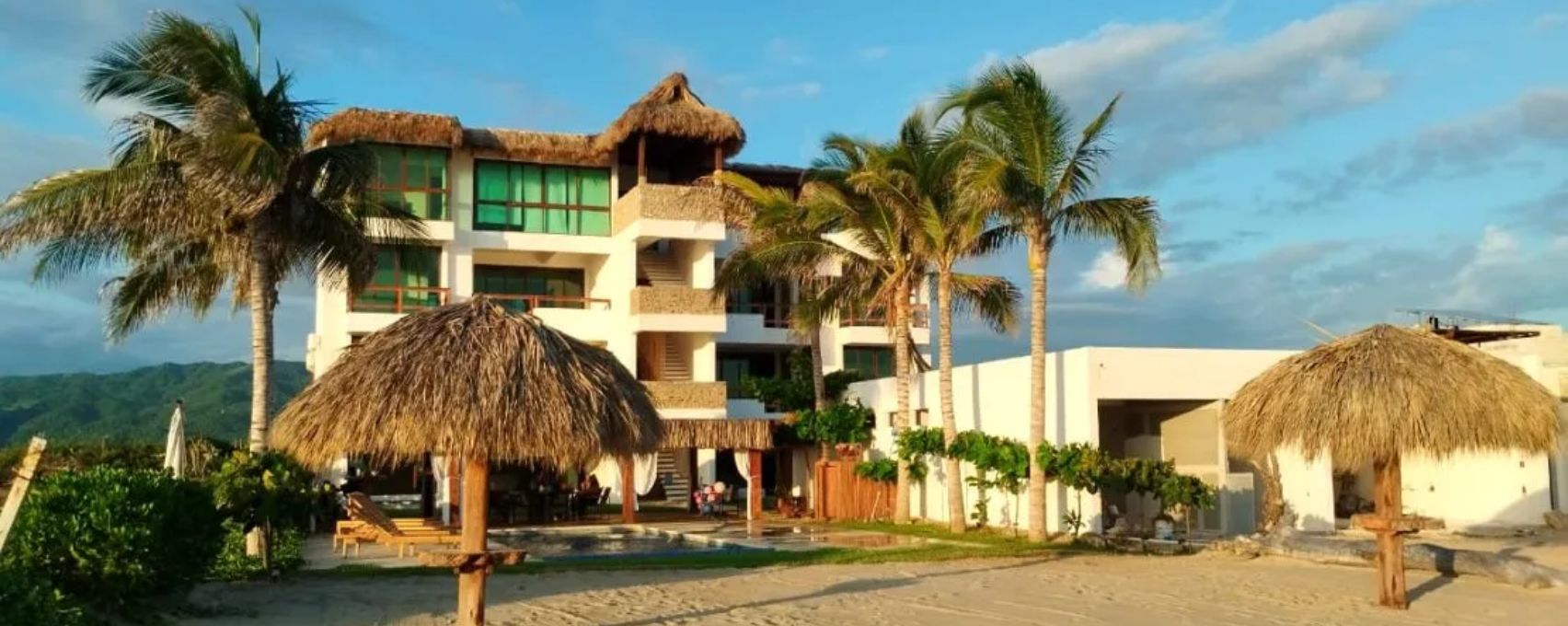
The Defining Elements of a Traditional Mexican Home in Puerto Escondido
The Palapa: Symbol of Coastal Living
No architectural element is more closely associated with the Oaxacan coast than the palapa. At its most basic, a palapa is a structure — sometimes free-standing, sometimes covering an entire house — built from a wooden frame and topped with layers of dried palm thatch. The material logic is elegant: palm leaves are locally abundant, renewable, naturally insulating, and surprisingly durable when applied with sufficient density and regular maintenance.
What the palapa does for a home goes beyond shade. A well-constructed palm thatch roof creates a microclimate beneath it, trapping a layer of cooler air that buffers the interior from the full force of the tropical sun. The loose weave of the thatch also allows moisture and heat to escape upward, functioning almost like a living ventilation system. On a hot afternoon in Zicatela or at a beachside property near Playa Principal, the difference between sitting under a palapa and standing in direct sun is immediate and profound.
Contemporary architecture in Puerto Escondido has embraced the palapa not as a rustic holdover but as a sophisticated building element. Projects featured in international publications like ArchDaily and Dezeen have showcased how local architects reinterpret the palapa through contemporary geometry while preserving its functional logic. At properties in La Punta and along the Barra de Colotepec corridor, palapa-roofed villas now command premium pricing precisely because they combine traditional performance with high design appeal.
Adobe and Stone: Thermal Mass on the Oaxacan Coast
In the inland and hillside areas around Puerto Escondido — in the colonias rising above Rinconada and Rinconcito, or in the rural ejido lands around San Pedro Mixtepec — adobe construction has historically been the default building method. Adobe bricks, made from a mixture of earth, water, clay, and organic fiber such as dry grass or straw, are formed by hand and dried in the sun. The result is a dense, thermally massive wall that absorbs heat through the day and releases it slowly through the cooler night hours.
Adobe homes on the Oaxaca coast tend to have thicker walls than modern concrete block construction, which gives them a distinctive, sculpted quality. Walls are typically finished with lime plaster — sometimes pigmented in the warm earth tones and ochres associated with Oaxacan craft traditions — and windows are set deep into the thickness of the wall, creating natural shade for the glass and the interior. The overall effect is a home that feels cool, quiet, and grounded in its landscape in a way that no modern building material quite replicates.
As noted by AMPI (Asociación Mexicana de Profesionales Inmobiliarios), the interest in authentic regional construction materials has grown steadily among buyers in destination markets across Mexico. In Puerto Escondido, this translates into real demand for properties that use or incorporate local stone, adobe-style finishes, and artisanal tile work — not just as decoration, but as structural and thermal strategy.
The Open Courtyard: Heart of the Traditional Mexican Home
One of the most enduring spatial features of traditional Mexican domestic architecture is the courtyard — the central open space around which rooms are organized and from which light and air flow into every part of the home. In Oaxaca’s urban vernacular, this tradition appears in the casas coloniales of Oaxaca City, with their grand stone arcades and flowering patios. On the coast, the courtyard is reinterpreted at a smaller, more intimate scale: a garden at the center of the home, a pool surrounded by living spaces, or simply a wide open terrace that connects the kitchen, bedrooms, and social areas without the need for enclosed hallways.
This spatial organization is not merely aesthetic. A central courtyard captures prevailing breezes and pulls cool air through the entire home by convection. It creates a private green space within the property — a garden, a place to sit, a buffer from the street. And it generates the indoor-outdoor flow that defines the best Puerto Escondido properties and makes them so compelling for vacation rental guests who arrive looking for an experience that feels different from an urban apartment or a hotel room.
Traditional Materials at a Glance
| Material | Traditional Use | Climate Benefit | Common Location in Puerto Escondido |
|---|---|---|---|
| Palm thatch (palapa) | Roofing, shade structures | Natural insulation, ventilation | La Punta, Zicatela, Bacocho beachfront |
| Parota & macuil wood | Structural frames, doors, lattice screens | Durability in humidity, natural shading | Throughout coastal neighborhoods |
| Adobe (earth brick) | Load-bearing walls | Thermal mass, passive cooling | Rinconada, Rinconcito, inland lots |
| Volcanic stone / cantera | Walls, foundations, decorative elements | Thermal mass, durability | Higher-elevation properties, Colotepec area |
| Lime plaster (cal) | Wall finish, waterproofing | Breathable, moisture-regulating | Traditional homes throughout the municipality |
| Handcrafted clay tile (barro) | Floors, roofing detail, decorative work | Cool underfoot, thermal balance | Interior finishes across all neighborhoods |
Traditional Homes by Neighborhood: What Buyers Find Today
Zicatela and La Punta
Zicatela and La Punta are the creative heart of Puerto Escondido’s real estate market, and the neighborhoods where the fusion of traditional and contemporary architecture is most visible. In the streets behind Playa Zicatela — Mexico’s most famous big-wave surf beach — you will find a mix of older, simply built homes with corrugated roofs and concrete block walls alongside newer boutique properties that incorporate palapa structures, parota wood detailing, and open tropical gardens. La Punta, at the southern end of the bay, has attracted a wave of design-conscious buyers who have commissioned homes and small hotels that draw heavily from vernacular traditions while adding modern amenities.
For buyers looking at houses and villas in Puerto Escondido, both Zicatela and La Punta offer a wide spectrum — from characterful older homes with authentic traditional elements to newly built properties that translate those same elements into luxury finishes. The palapa roof, the open-plan ground floor, and the outdoor shower remain defining features of the aspirational property in both colonias.
Carrizalillo and Bacocho
Carrizalillo, overlooking the sheltered beach of the same name, and Bacocho, the established residential zone to the west of the main bay, are home to some of Puerto Escondido’s most comfortable mid-to-upper-range residential properties. The lots here tend to be larger than in Zicatela, and the presence of established gardens and mature trees gives many properties a settled, shaded quality that is particularly prized in the tropical heat.
Traditional home elements here appear most often in the outdoor spaces: wide terraces sheltered by palapa roofs, tiled swimming pools, and kitchen-dining areas that flow seamlessly from the interior to a shaded garden. The building fabric of many homes in Carrizalillo and Bacocho dates from the 1990s and early 2000s — an era when concrete block was the dominant construction method — but buyers today often commission renovations that reintroduce traditional materials: clay tile floors, lime plaster finishes, hand-carved wooden details, and palapa-covered terraces that transform a utilitarian structure into a genuinely appealing coastal home.
Rinconada, Rinconcito, and the Colotepec Corridor
For buyers who want something closer to the original vernacular — unmodified, unhurried, and still deeply connected to the working life of the coast — the colonias of Rinconada and Rinconcito, along with the rural land corridor running toward Colotepec and Barra de Colotepec, offer the most authentic experience of traditional Mexican coastal construction. Here, older homes built in adobe or simple concrete block with traditional lime finishes survive alongside newer builds on generous lots.
The Colotepec corridor, situated within the municipality of Santa María Colotepec and increasingly linked to Puerto Escondido’s real estate market following the completion of the Barranca Larga–Ventanilla superhighway, is particularly interesting for buyers who want to build from scratch on land that allows full creative freedom. Land lots in the Puerto Escondido area in this zone offer the opportunity to design a home that draws fully on traditional Oaxacan vernacular — with the guidance of a local architect — without the constraints of an existing structure.
Traditional Architecture and Real Estate Value: What the Market Tells Us
The relationship between traditional design elements and property value in Puerto Escondido has become increasingly clear over the past decade. What was once considered a rustic or informal building approach — palm roofs, earthen walls, open layouts — is now recognized as a genuine asset in both the residential and vacation rental markets. There are several reasons for this shift.
First, there is the experiential dimension. Visitors who travel to Puerto Escondido — whether from Mexico City, the United States, Europe, or increasingly from Asia — are seeking an experience that feels rooted in place. A home with a palapa roof, a garden full of tropical planting, handmade tile floors, and the sound of the wind through parota wood screens delivers exactly that. It is not something a generic concrete box can replicate, and guests and buyers alike are willing to pay meaningfully more for it.
Second, traditional construction in this climate is genuinely practical. Passive cooling through thick walls, shaded terraces, cross-ventilation, and palapa roofing reduces dependence on air conditioning — a significant operating cost in any rental or residential property on the coast. Properties that are comfortable without mechanical cooling are cheaper to run, easier to maintain, and more resilient to the seasonal electricity variability that affects coastal Oaxacan communities.
Third, the architectural quality of vernacular-inspired design in Puerto Escondido has attracted international attention. Projects published in leading architecture and design media have positioned the town as a serious design destination — a status that reflects directly on property values, particularly at the higher end of the market where buyers are often design-literate and quality-conscious.
Buying a Traditional Home: Key Considerations
- Palapa maintenance: Traditional palm thatch roofs typically require re-thatching every 5 to 8 years depending on exposure, quality of installation, and storm frequency. Factor this into ownership costs and budget for it proactively.
- Adobe and earthen walls: Adobe performs exceptionally well in dry conditions but requires good roof overhangs and proper waterproofing at the base to avoid moisture infiltration during the rainy season. Annual inspection of lime plaster finishes is advisable.
- Fideicomiso requirement: Puerto Escondido lies within Mexico’s zona restringida (restricted zone), defined as the area within 50 kilometers of the coastline. Foreign buyers must purchase through a fideicomiso — a bank trust — that grants all ownership rights while complying with Mexican law. A qualified notario público handles the formalization of the escritura (title deed).
- Municipal permits: Any restoration or construction work on a property in Puerto Escondido requires permits from the municipal authority. The local building regulations for the municipalities of San Pedro Mixtepec and Santa María Colotepec govern height limits, setbacks, and land use. Verify zoning and permitted uses before purchase.
- Structural assessment: Older traditional homes — particularly those built before the 1985 earthquake-resistant code reforms — should be assessed by a local structural engineer before purchase. Adobe and stone construction can be excellent but may require seismic reinforcement depending on age and condition.
- Title verification: Confirm clean title, verify there are no ejido land complications, and check for any ZOFEMAT (federal maritime zone) restrictions on coastal properties. Your notario will guide this process.
Renovation vs. New Build: Comparing Your Options
| Scenario | Advantages | Challenges | Best For |
|---|---|---|---|
| Restore an existing traditional home | Authentic character, established location, mature garden | Hidden structural issues, permit process, skilled craftspeople required | Buyers wanting character and history |
| Build new with traditional elements | Full design control, modern systems with vernacular aesthetic | Land sourcing, permit timeline, contractor coordination | Investors, custom-home buyers |
| Buy a modern home and retrofit traditional features | Move-in ready, lower immediate cost | Retrofit can feel cosmetic without skilled design | Buyers on a timeline, vacation rental investors |
The Investment Case for Traditional Mexican Homes in Puerto Escondido
Puerto Escondido’s real estate market has evolved significantly over the past five years. The completion of the Barranca Larga–Ventanilla superhighway reduced travel time to Oaxaca City to approximately 2.5 hours. The 2025 launch of United Airlines’ direct service from Houston opened a new gateway for North American travelers and buyers. These infrastructure improvements have brought a wave of new interest from buyers who want a property on the Oaxaca coast but need reliable connectivity to the rest of the world.
For these buyers — often second-home seekers, remote workers, or investors looking to enter the vacation rental market — a traditional Mexican home in Puerto Escondido represents something genuinely rare: an authentic coastal property in a market that is still accessible by international comparison, with strong short-term rental demand, a growing design reputation, and a clear appreciation trajectory. As the industry publication Inmobiliare has noted, coastal Oaxacan destinations like Puerto Escondido are among the strongest-performing segments of Mexico’s wider real estate market.
Explore our current portfolio of available properties in Puerto Escondido, including houses and villas with traditional character and hot sale listings that represent genuine value in today’s market.
Frequently Asked Questions
What is a palapa and why is it common in Puerto Escondido homes?
A palapa is an open-sided structure with a thatched roof made from dried palm leaves and a wooden frame. In Puerto Escondido, palapas are common because they provide natural insulation from the coastal heat, allow ocean breezes to circulate freely, and connect the home to the local vernacular tradition. They function both as standalone outdoor shelters and as the primary roofing element of entire residences.
Are traditional Mexican homes a good real estate investment in Puerto Escondido?
Yes. Properties that incorporate traditional architectural elements — palapa roofs, natural materials, open indoor-outdoor layouts — consistently attract strong interest from vacation rental guests and foreign buyers seeking authentic coastal experiences. Well-executed traditional or vernacular-inspired homes in neighborhoods like Zicatela, La Punta, and Carrizalillo perform above the market average for both short-term rentals and long-term appreciation.
Can foreigners buy traditional homes in Puerto Escondido?
Yes. Foreign nationals can purchase property in Puerto Escondido through a fideicomiso — a bank trust that grants the buyer full ownership rights while complying with Mexican law regarding the restricted zone. All transactions are formalized before a notario público. Consulting a qualified notario and a Mexican real estate attorney is strongly recommended before signing any contract.
What traditional materials are used in Oaxacan coastal homes?
Traditional homes on the Oaxacan coast commonly use dried palm thatch (for palapa roofs), parota and macuil wood, adobe (sun-dried clay bricks), local volcanic stone, handcrafted clay tiles, pigmented lime plaster, and locally sourced cantera stone. These materials are prized for their thermal performance, sustainability, and visual connection to the regional landscape.
Which Puerto Escondido neighborhoods have the best examples of traditional Mexican homes?
La Punta and Zicatela are home to many architecturally distinctive properties blending traditional and contemporary elements. Rinconada and Rinconcito preserve older colonia-style houses with traditional layouts. Bacocho features larger lots where palapa-roofed villas are common. Barra de Colotepec and Colotepec offer rural-style land plots where buyers can build in a fully traditional style with a clean slate.
Conclusion
Traditional Mexican homes in Puerto Escondido are not relics. They are a living architectural language — refined over centuries to perform brilliantly in this specific climate, built from materials that age beautifully, and organized around spaces that make daily life on the Oaxacan coast genuinely pleasurable. For buyers and investors, they represent a combination of authentic experience, practical performance, and strong market appeal that is genuinely difficult to replicate with modern construction alone. Whether you are looking to restore an older home in Rinconcito, build a palapa villa on a land lot in Colotepec, or invest in a character property in Zicatela or La Punta, the traditional principles that shaped this architecture are your most reliable guide to what will hold value and attract demand for years to come. Reach out to our team at Real Estate Puerto Escondido for a personalized consultation — we know this market from the inside, and we are here to help you find the right property.
Disclaimer: This article is intended for informational purposes only and does not constitute legal, financial, or real estate advice. Real estate transactions in Mexico involve legal complexities that vary by property type, location, and buyer profile. Always consult a qualified notario público, licensed real estate attorney, and certified contador before making any property purchase decision.